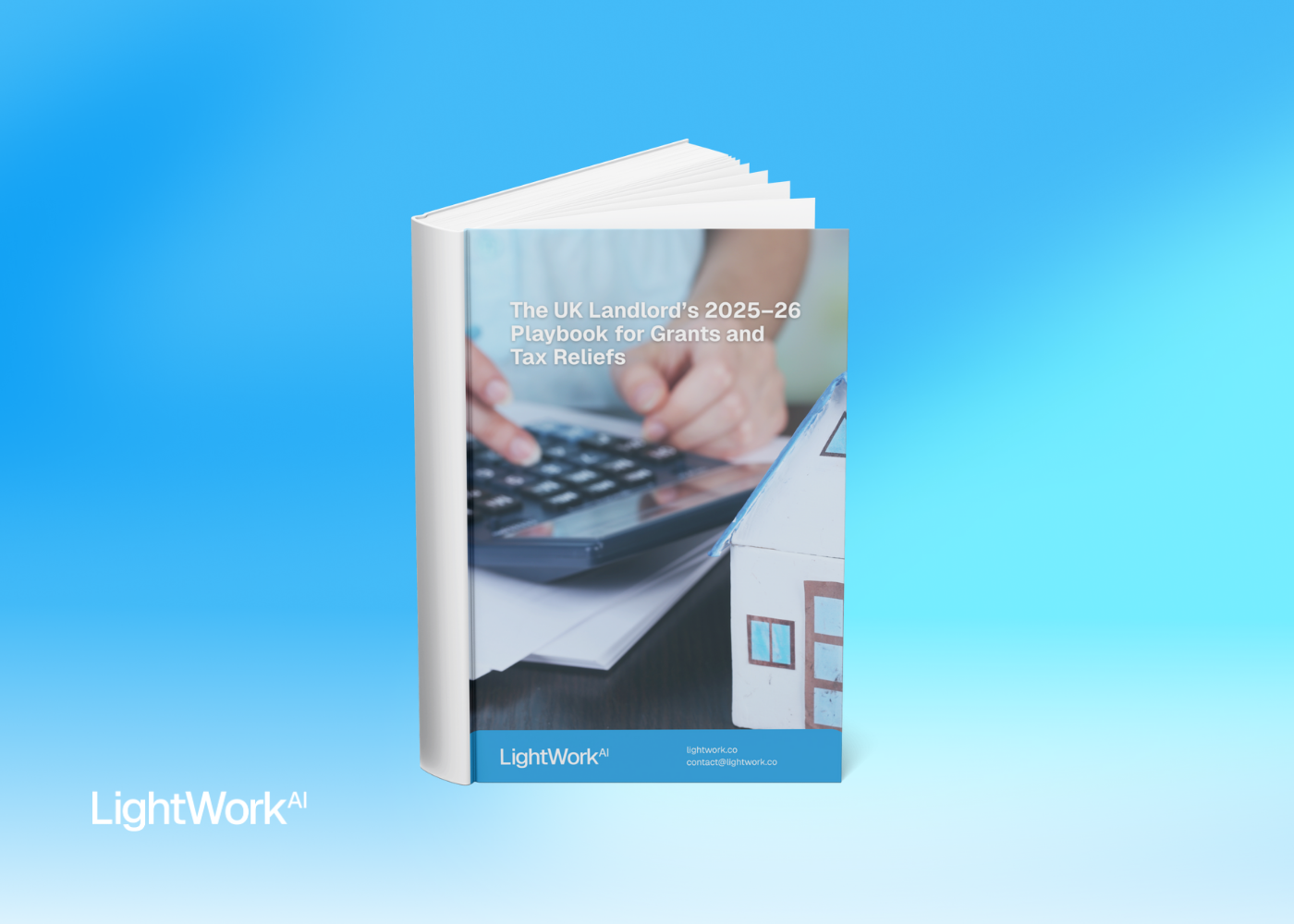
The UK Landlord’s 2025–26 Playbook for Grants and Tax Reliefs
This guide explains how landlords can leverage UK government grants, tax reliefs, and rental support schemes to enhance their portfolio’s asset value in 2025/2026.

Rising prices, volatile mortgage rates, and hidden costs of increasing regulatory risk are burying landlords in day‑to‑day management, making compliance in property management often seen as a cost rather than a source of value.
The UK government offers a wide range of grants and incentives to improve the housing stock, landlords risk leaving thousands of pounds in unclaimed tax reliefs and programmes.
One of the most significant areas of financial support for landlords focuses on improving the energy efficiency of their rental properties.
The current legal minimum for the domestic Private Rented Sector (PRS) is EPC band E in England and Wales. As of 27th October 2025, under the Renters' Rights Act (previously the Renters' Rights Bill), it is now law that the PRS minimum will be raised to EPC band C for new tenancies from 2028 and for all tenancies by 2030.
Energy Upgrades that pay
Separately, there are time‑limited opportunities to access government‑run programmes, such as Energy Company Obligation (ECO4) and the Great British Insulation Scheme (GBIS) which are scheduled to run until 31 March 2026.
The Energy Company Obligation (ECO4)
The ECO4 scheme, administered by Ofgem, obligates energy suppliers to fund and deliver whole-house energy upgrades across Great Britain. The scheme primarily focuses on the least-efficient homes. A property can qualify if both the household and the property itself meet the required criteria.
How Landlords can use ECO4 step‑by‑step
- Ask your council if it participates in ECO4 Flex and confirm household eligibility for your tenancy.
- If so, choose a registered installer to deliver under ECO4; they will coordinate with an obligated supplier.
- Book a PAS 2035 whole‑house assessment as it underpins the measure plan.
- Gather documentation such as EPC, tenancy details, photos, bills, and tenant consent.
- Plan to complete before 31 March 2026 unless an extension is confirmed.
Great British Insulation Scheme (GBIS)
GBIS is a government-backed scheme that mostly funds a single insulation upgrade per home, although a recent rule change now allows for two measures (e.g., loft plus cavity wall) in some situations. The public referral service is closed to new applications, so landlords should contact obligated energy suppliers or approved installers directly to check eligibility.
Both the Great British Insulation Scheme (GBIS) and ECO4 are scheduled to conclude on 31 March 2026, creating a limited timeframe for landlords to utilise the available funding.
These schemes present an opportunity for property owners to upgrade their rental portfolios at low or no cost. Making them compliant with future proposed regulations and potentially saving thousands of pounds in upgrade costs
The Boiler Upgrade Scheme (BUS)
The Boiler Upgrade Scheme (BUS) offers a £7,500 grant towards an air- or ground-source heat pump, or £5,000 for a biomass boiler (for rural, off-gas properties that meet emissions standards).
As the scheme is installer-led, landlords must choose an MCS-certified installer. The installer then applies for the grant on the landlord's behalf and discounts the grant amount directly from the final quote. Private landlords are fully eligible.
Funding for the scheme is finite and allocated on a financial year basis, with approximately £295m allocated for 2025/26. The scheme is currently funded until the end of the 2027/28 financial year, making early application advisable.
The installation must be commissioned within a specific timeframe after the voucher is issued: three months for air-source heat pumps and biomass boilers, and six months for ground-source heat pumps.
It is permissible to combine the BUS grant with other schemes for different measures (e.g., using GBIS for insulation). However, regulations prohibit using more than one grant for the same heat pump or biomass system.
Home Upgrade Grant (HUG2)
Another significant opportunity is the Home Upgrade Grant (HUG2), a local authority-administered fund for energy efficiency improvements in homes that are not connected to the main gas grid.
Landlords cannot apply directly but must work with their local council and have an eligible tenant. Access is determined by a combination of factors: the property must be off-gas, possess a low EPC rating of D or below, and the tenant must meet the council's low-income criteria.
Adaptation, Safety, and Value-Add Grants
Beyond direct energy upgrades, several other grants and schemes provide targeted financial support. These incentives help landlords adapt properties for specific tenant needs, bring derelict homes back to life, and adapt their assets for a changing market.
Disabled Facilities Grant (DFG)
A key form of support is the Disabled Facilities Grant (DFG), a mandatory, council-run grant designed to fund essential adaptations that enable a disabled tenant to live safely and independently.
Councils are required to provide it if the criteria are met. The grant funds a wide range of work, including the installation of stairlifts, the construction of accessible ramps, the widening of doorways, and the creation of level-access bathrooms.
The landlord's role is to provide formal permission for the works. With a value of up to £30,000 in England.
EV Charge-Point Grant for Landlords
To future-proof a property for the modern transport era, landlords can use the EV Charge-point Grant. This government scheme, administered by OZEV, reduces the cost of installing electric vehicle charge-points at rental properties.
It is specifically designed for landlords and owners of apartment blocks, who can apply for grants across multiple properties. The grant provides up to 75% of the cost of buying and installing a charge-point, capped at £350 per socket.
The process is also installer-led, meaning the landlord must use an OZEV-approved installer who will claim the grant on their behalf and deduct it from the final invoice.
Empty Property Grants & Loans
Landlords can explore Empty Property Grants and Loans, which are highly localised schemes run by councils to bring long-term empty or derelict properties back into use.
The rules for these schemes vary significantly between councils, but the funding is almost always tied to a key condition: the landlord must agree to rent the refurbished property through the council's own scheme or to nominated tenants for a set period, often three to five years.
The support may come as a non-repayable grant for specific refurbishments or a low-interest loan to fund the entire project.
Navigating Tax Reliefs
Beyond the fundamentals of record-keeping, true tax optimisation for landlords lies in strategic planning. This begins with expertly navigating the fine line between a deductible repair and a capital improvement to secure immediate tax relief.
Replacement of Domestic Items Relief (RDI)
Landlords can claim tax relief on the cost of replacing movable domestic items, such as beds, sofas, white goods, and carpets. If an item is upgraded during replacement, the claim is capped at the cost of a modern, like-for-like equivalent.
Fixtures (e.g., boilers, radiators, built-in kitchen units) do not qualify for RDI. However, repairs to such items may still be claimed as an allowable expense. The specific rules for this relief are outlined in HMRC’s Property Income Manual, section PIM3210.
The Strategic use of LightWork AI
The grants, reliefs, and schemes detailed in this playbook represent thousands of pounds in potential value. However, feeling overwhelmed by rising regulatory risk can prevent landlords from capitalising on these opportunities.
Juggling applications for ECO4, coordinating installers for a BUS grant, and documenting eligibility for HUG2, all while managing the stricter compliance duties of the Renters' Rights Act is a monumental task.
An AI platform like LightWork AI, which automates compliance and maintenance, reduces this administrative burden and turns complex processes into manageable, evidence-backed workflows.
For landlords pursuing the grants in this guide, LightWork AI provides the operational backbone:
- Automate reminders for time-sensitive opportunities, such as the March 31, 2026, conclusion of the ECO4 and GBIS schemes, or the voucher expiry dates for the Boiler Upgrade Scheme.
- Securely log all maintenance activity, communications with tenants and installers, and collect remedial documents like quotes and certifications.
- LightWork AI generates a complete audit trail for every job, including dated photographs, invoices, and communication logs.
LightWork AI transforms the administrative burden of compliance and grant-seeking into a streamlined and strategic advantage. See how LightWork AI can help, or book a demo today.
Get Your Free 2025–26 UK Landlord Grants & Tax Relief Checklist Here!
Stay compliant and protect your rental income. Download the complete 2025–26 Landlord Grants & Tax Relief Checklist for a step-by-step guide to every major scheme and deadline. Perfect for planning upgrades across multiple properties.